
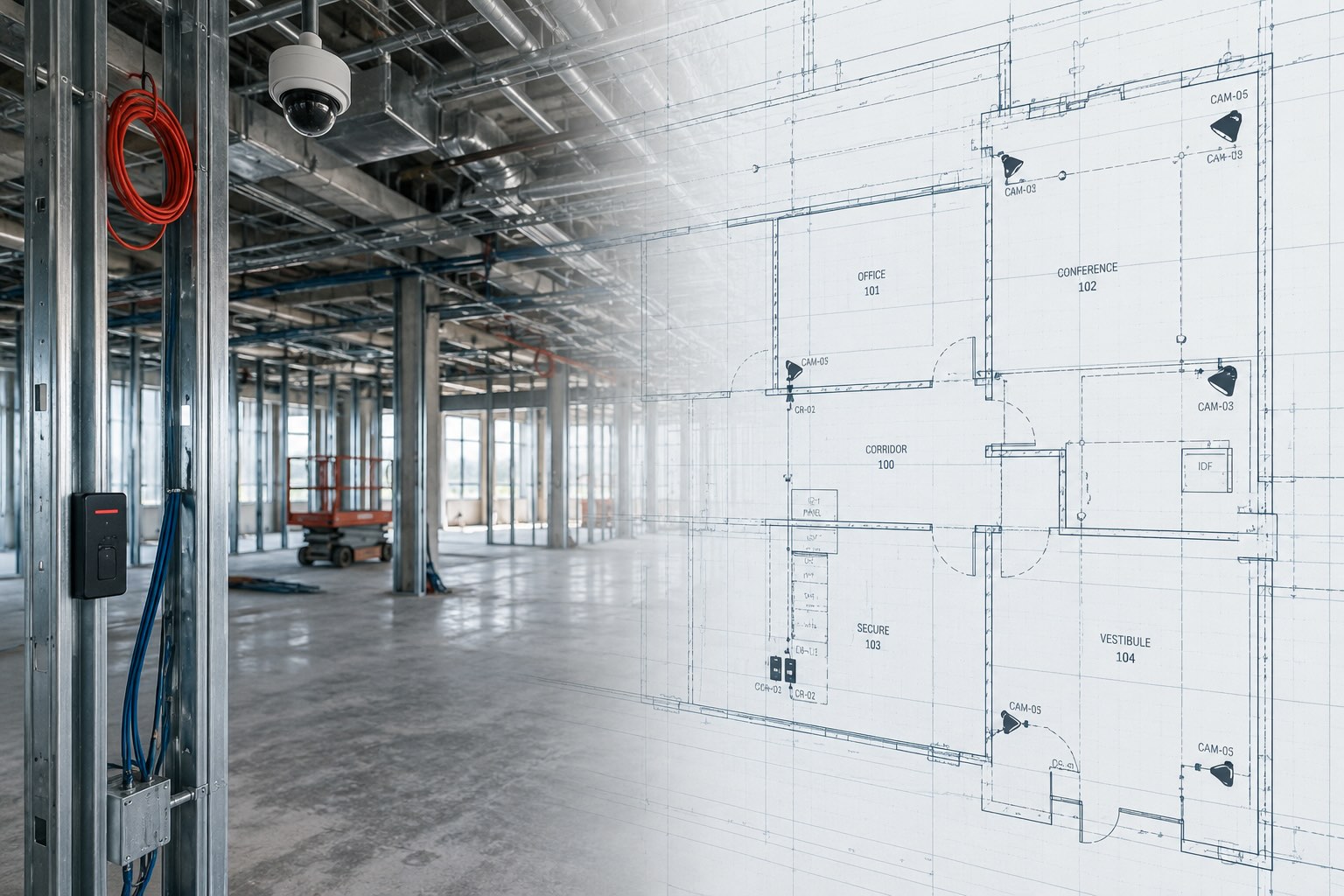
What Field Experience Brings to Security System Design
Field experience adds practical insight to security design, helping improve constructability, coordination and maintenance...
As projects become more complex, design teams are managing more information than ever before. From data center connectivity and power requirements to workplace technology standards, traditional building information modeling (BIM) workflows can struggle to keep pace with the volume of data and the speed of change required by modern projects.
To address these challenges, TEECOM has been developing BuildScript®, an information-first approach to building design that applies software development principles to the built environment.
We sat down with members of TEECOM’s Research & Development team, including Alex Serriere and Tyler Kvochick, to answer some of the most common questions about BuildScript and how it is transforming the design process.
Traditional BIM workflows typically begin with creating and manipulating 3D geometry. While BIM stands for Building Information Modeling, many project teams spend most of their effort managing the model itself rather than the information behind it.
BuildScript reverses that approach.
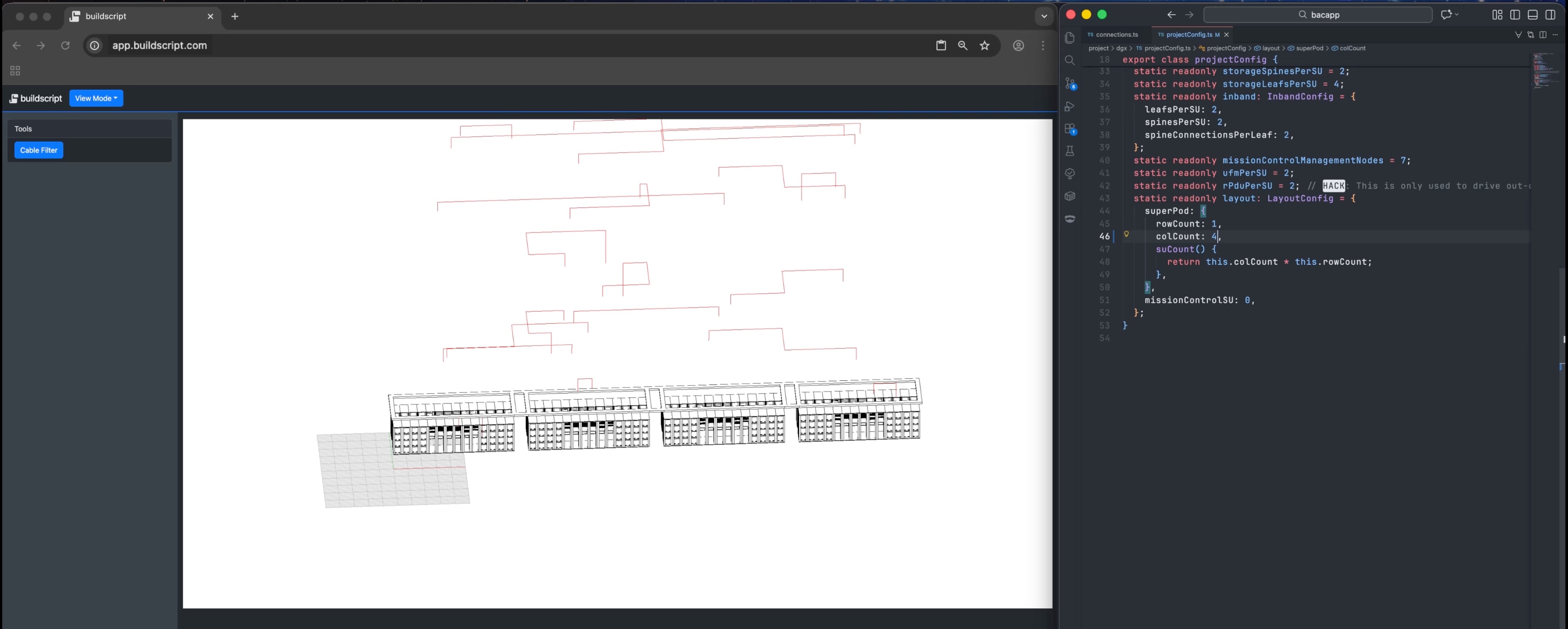
Instead of manually creating building elements one by one, BuildScript starts with the information that defines a building. Requirements, standards, relationships, and constraints are encoded in a domain specific language (DSL). From that information, design deliverables and models can be generated automatically.
In other words, BuildScript takes an information-first approach rather than a model-first approach. By encoding design intent directly into software, teams can generate and maintain models that remain aligned with project requirements throughout the design process.
No.
While familiarity with basic computer concepts is helpful, users do not need a background in software engineering to benefit from BuildScript. Anyone who has created a complex spreadsheet, developed formulas, or organized structured information already understands many of the same principles.
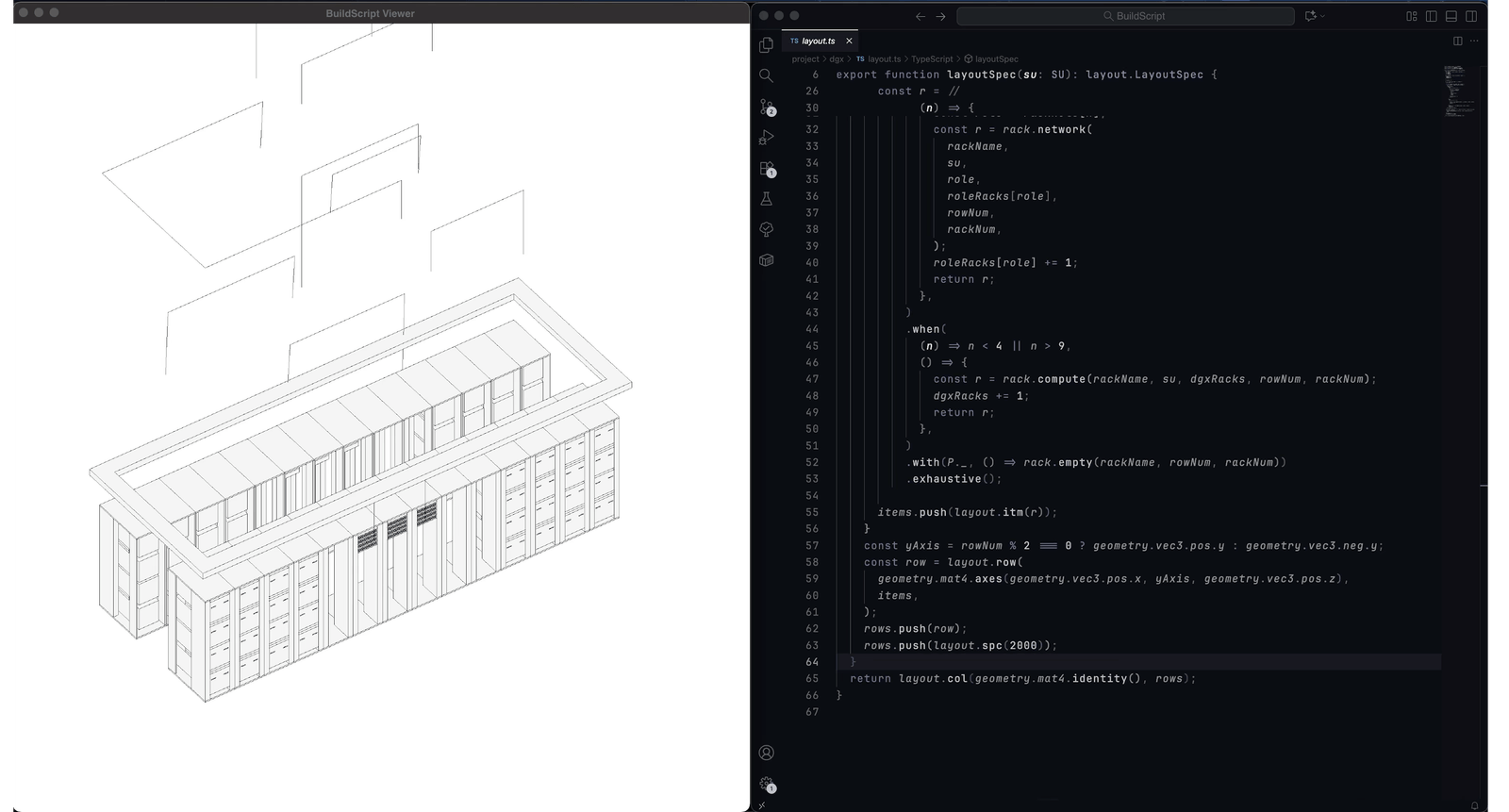
The goal is not to turn designers into software developers. Instead, BuildScript provides a structured way to communicate design requirements and standards using text-based definitions that computers can understand and execute. The outputs from BuildScript include interactive 3D models, tabular database, and 2D technical diagrams. All the materials that AEC professionals are used to using.
BuildScript helps identify errors much earlier than traditional workflows.
In many BIM platforms, designers can create configurations that may not be constructible or compliant with project standards. Those issues are often discovered later during reviews or coordination meetings.
BuildScript allows project teams to define acceptable design conditions and constraints directly within the design logic. If a proposed configuration violates those requirements, the system can immediately flag the issue rather than allowing it to move further downstream.
Additionally, BuildScript incorporates software development practices such as testing, validation, version control, and continuous integration. These automated checks help identify potential issues before they become costly design revisions.
Change is inevitable on complex projects.
Because BuildScript stores design information as structured, version-controlled text, teams can track exactly what changed, when it changed, and why.
For many types of changes, updating a requirement can be as simple as modifying a parameter and regenerating the project deliverables. Similar to updating a value in a spreadsheet and watching the calculations update automatically, BuildScript can rapidly produce revised outputs based on new requirements.
More significant changes may still require modifications to the underlying design logic, but the ability to automatically update deliverables dramatically reduces the effort associated with many common revisions.
Projects that involve significant complexity, repeatable standards, and large amounts of interconnected information stand to benefit the most.
Data centers are a strong example. Modern AI data centers contain thousands of devices, fiber connections, power requirements, and technology systems that must all work together. Managing that information manually becomes increasingly difficult as projects scale and replicated throughout an operational region.
BuildScript enables teams to encode standards, connectivity requirements, equipment information, and design rules directly into the project definition, making it easier to manage complexity while maintaining consistency.
Organizations with established design standards and repeatable project types will see particularly significant benefits.
Absolutely.
While many of the current applications focus on mission critical environments, the underlying principles apply to any project that relies on standards, technology infrastructure, and repeatable requirements.
Workplace environments are a natural example. Modern offices contain extensive technology systems, collaboration spaces, security infrastructure, and connectivity requirements. BuildScript can help organizations standardize these elements and deploy new facilities more efficiently.
Any project where consistency, scalability, and information management are important can benefit from the approach.
No.
BuildScript is not intended to replace engineering or design expertise. Instead, it amplifies it.
In traditional workflows, engineers and production teams often spend significant time placing and coordinating individual elements within a model. BuildScript allows teams to define the rules governing those elements once and then apply them consistently across projects.
Rather than spending time on repetitive modeling tasks, engineers can focus on higher-value activities such as problem-solving, system design, and evaluating alternatives.
The result is greater leverage for design professionals, not less.
AI has been particularly effective in software development because software benefits from short verification cycles. Developers can write code, run automated tests, and quickly determine whether something works as intended. Programming languages also include built-in error checking that helps prevent many common mistakes before they become larger problems.
BuildScript brings those same principles to building design. By encoding requirements, standards, and constraints in a machine-readable format, it creates opportunities for automated validation and error checking throughout the design process.
As AI tools and autonomous agents become more capable, this foundation becomes increasingly important. BuildScript provides a framework that allows AI systems to not only generate design solutions, but also verify their outputs against project requirements and identify potential issues before they move downstream.
One of BuildScript’s greatest advantages is the speed of feedback.
When project requirements change, teams can rapidly regenerate design outputs and evaluate the impact of those changes. This shortens the feedback loop between an idea, a design decision, and a measurable result.
Because information is structured and connected, teams can more quickly assess impacts related to configuration, connectivity, equipment selection, and cost.
Faster feedback enables faster and more informed decision-making.
Virtually any requirement that can be represented digitally can be incorporated into a BuildScript workflow. Examples include:
Rather than being limited by the capabilities of a specific design tool, owners can focus on defining the requirements that matter most to their organization.
BuildScript leverages many of the collaboration tools and practices that have become standard within software development.
Because project definitions are stored as text, teams can use version control systems to track every change, identify who made it, and understand why it was made.
This creates greater transparency and accountability while enabling multiple disciplines to collaborate around a shared, computable definition of project requirements.
The result is a new level of coordination that extends beyond what is typically possible in traditional BIM workflows.
One common misconception is that BuildScript is simply another parametric design tool.
While BuildScript can generate design outputs based on parameters, the code itself becomes the design definition.
Traditional parametric tools often serve as mechanisms for producing deliverables. BuildScript goes further by treating the encoded requirements, standards, and relationships as the primary design artifact.
The script is not merely generating the design. It is the design.
Successful BuildScript projects are characterized by flexibility, consistency, and confidence.
Design changes can be accommodated without extensive rework. Deliverables can be generated quickly and reliably. Teams can manage greater levels of complexity without increasing cognitive burden on designers and engineers.
Perhaps most importantly, organizations gain a reusable standards framework that can be applied across future projects, reducing errors and enabling more informed decision-making over time.
As building systems become more interconnected and project requirements continue to grow in complexity, design teams need new ways to manage information, evaluate options, and deliver consistent outcomes. BuildScript represents a shift from drawing-centric workflows to information-centric design, applying proven software development principles to the built environment. While still evolving, the approach is already demonstrating how standards, automation, and structured data can help teams move faster, reduce errors, and make better decisions throughout the project lifecycle. For owners and design teams alike, BuildScript offers a glimpse into a future where building design is not only more efficient, but also more adaptable, scalable, and resilient.
Contact us to learn more about how BuildScript can accelerate your work.
Alex Serriere is TEECOM’s Principal, Executive Vice President of R&D. Alex has spent over 15 years driving TEECOM’s commient to innovation and future-proofing client solutions. His research and leadership ensure the team remains current on the latest technology trends and maximizes long-term flexibility for mission-critical facilities. Today, Alex’s team focuses on developing the advanced tools required to manage the complexity of the world’s most sophisticated buildings, including BuildScript.
Tyler Kvochick is TEECOM’s Director of Research. He focuses on planning, developing, and testing new approaches to system design that enhance quality and efficiency in the AEC industry. With a master’s degree in architecture and extensive experience as a software developer in construction technology, Tyler possesses a unique cross-disciplinary background. He is driven to create sophisticated yet practical tools, like BuildScript, that help eliminate errors, information loss, and ambiguity in complex facility projects.
Stay ahead of the curve with our latest blog posts on industry trends, thought leadership, employee stories, and expert insights.